Showing posts with label help. Show all posts

Monday, February 17, 2014

Frequently Asked Question: How Common is Incest?

This summary is not available. Please click here to view the post.

Saturday, February 15, 2014

Help for Friends and Family of Consanguinamorous Siblings

Our friend Gott has done great service and had given this blog permission to repost what was just posted on Tumblr. I recommend following that Tumblr blog. What is below is all Gott's work...

(Here is a PDF version of the full text)

This is for the benefit of friends or family of romantically involved siblings, who may have recently discovered their secret. Though I’ve used “incest” in the title, I won’t continue to use the terms “incest” or “incestuous,” I will use “consanguinamory” and “consanguineous” (pronounced “con-sang-gwin-am-or-ee” and “con-sang-gwin-ee-us). “Incest” is too loaded a word for intelligent discussion, and I only ever use it for sexual abuse. If I say “consanguinamory”, assume I am talking about consensual sex. (I’m going to assume that the couple is opposite-sex, but most of this also applies for same-sex couples.) Remember: there’s a difference between love and abuse.
This might be long, but bear with me. All of your concerns are about to be addressed. If you truly love them, you will have the patience to read this.


- INTRODUCTION

First, stop and take a breath. I know that this must be a lot to take in. I seriously doubt that you’ve ever sat down to consider the possibility of this happening. I don’t expect you to be calm, but I do expect you to care enough about their well-being to seriously consider what I’m about to say.

Did you discover them accidentally? If so, talk to them individually – with an open mind – and make sure that there was no coercion. Ignore the taboo nature of what you just found out. If you have no evidence of coercion or manipulation, then do not try to project abuse where there is none, and do not force them to internalize your own sense of what’s “taboo.” Why would you ever want to burden them with so much unnecessary guilt and shame? Talk to them together, and get the story from them, calmly. See how they act together. Remember to treat them with respect, especially if they’re already adults; it’s what you would want for yourself.

Did they come out to you on their own? Then there’s even less chance that there was any coercion involved. In fact, coming out to you is one of the bravest and most trusting gifts they could ever give you. Not only is their love extremely taboo, but even if they are adults, in most places on Earth they could be thrown in jail, possibly for the rest of their lives. You could get them thrown in jail. Every person they tell is a potential threat who could ruin their lives forever, getting them locked up for years and permanently placed on the sex-offender registry. And yet, despite all that, they told you. They could have lied – it wouldn’t have been easy, but they could have – but they told you. However much you thought they trusted and loved you, they just proved that their true trust and love is greater.


If they say that it’s consensual, and there’s no evidence it isn’t – especially if they came forward on their own – how can you still assume that no person could consent to it? How can you possibly disrespect their intelligence and agency so much? Have you ever had any other reason to doubt that they are of sound mind and soul? Then why should this one thing counteract years of personal experience? Did they hurt anyone? Of course not. If you think there must be something wrong, it’s because that’s the story society has been spoon-feeding you.

Consider: if one of them was adopted – if they weren’t genetically related – would you still feel as uncomfortable as you do? Because if you wouldn’t, then there’s no good reason for your discomfort now; socially, whether adopted or not, their relationship would be the same. If they weren’t even raised together, then in no way are they family, though they are blood relatives. Ignore for a moment the particular, taboo nature of their relationship. Just consider them as individual people. If your daughter/sister/friend was dating a man like her brother, knowing everything you do about him, would you be displeased, or happy? If your son/brother/friend were dating a woman like his sister, knowing everything you do about her, would you be upset, or glad?

If you are their parent, unless you’ve done an awful job of raising them, my guess is that, before you found out, you were quite proud of them. Well, they’re the same people now, the same people who made you proud. Wouldn’t you want your daughter to date a man who made you as proud as your son? Wouldn’t you want your son to date a woman who made you as proud as your daughter? Aren’t they more to you, and to each other, than just their genes?

- MENTAL HEALTH
 
Society has taught you to feel a certain way about consanguinamory. It was handed to you, and you accepted it without much thought. You’ve probably never met anyone who was openly sexually involved with a close family member. This has allowed you to go around without seriously considering what such a relationship might look like, how it could work, and how you should feel about it. It has allowed you to absorb the limited perspective put out by the media, giving you a narrow, stereotyped view of what’s possible. You have been listening to only one side of the story your whole life.

Just because you don’t know that you’ve met such a couple before, doesn’t mean that you haven’t met one. In fact, as you follow your family tree further and further back in time, the probability that you will find at least one consanguineous couple approaches 100%. Self-reported surveys have found that as much as 10% of college students have had consensual sexual contact with a sibling (mostly childhood experimentation). (If we extrapolate this to the whole population, this equates to about 30 million people in the U.S.) The fact that a couple is related tells you exactly nothing about what their relationship is like, nor whether it is consenting or not, nor whether it is fulfilling or not. Each of those things is independent of their blood relationship.

The cultural stereotype of such relationships is that they are dysfunctional, self-destructive, and abusive; anyone who willingly participates must somehow be mentally ill. Besides this view being incredibly condescending, it also has no meaningful basis. What is considered “healthy” and “unhealthy” changes, and is very subjective. On what standard are we to decide what constitutes mental “illness?” Is it that they’re doing something they know society disapproves of? I don’t think any reasonable person thinks we should use the preconceptions of the majority to decide what constitutes mental illness. It must, then, be that the behavior is self-destructive, or causes them to destroy the lives of others.

Do you see anything indicating that those things are happening? Aside from their experience of bigotry, do they seem unusually disturbed? Are they lashing out at themselves, at each other, or at you? Are they unable to operate normally in a social environment? If not, then you have no reason to think they are any less mentally healthy than before. In fact, their love may have made them healthier, by bringing them fulfillment and peace.
“From a scientific perspective, we do not know what constitutes normal childhood sexual behavior or feelings. […] Sexual behavior varies drastically among different groups of people due to their moral beliefs, values, social class, and culture. Sexual feelings and behaviors also vary widely among youth due to individual differences and variations in development. […] Some of the behaviors mentioned above are harmful. However, many are socially unacceptable because they would be classified as immoral or indecent by many people, not because they are harmful.
As I’ve said, you’ve probably already met a consanguineous couple. They couldn’t have stood out as any more dysfunctional than the average couple, or you would have become suspicious that something was wrong. Unfortunately, prejudice keeps people in the closet, which perpetuates ignorance, which itself perpetuates prejudice. You have been given the rare opportunity to examine your own assumptions, and break your own cycle of prejudice. Most people have never gotten that chance.

The “pedophile” label has long been used to brand sexual minorities as deviants, as threats to society and to our children. Homosexuality has long been heavily attacked as pedophilic, and in the past when people had limited experience with open, healthy same-sex relationships, they believed the propaganda. Now that so many homosexual couples are out in the open, we realize that there is a clear difference between the consenting majority, and the predatory minority.

Even today, opponents of legal rights for homosexuals try to brand the gay rights agenda as pro-pedophilia. There is a homophobic Neo-Nazi “vigilante” group in Russia called “Occupy Pedophilia,” but it isn’t pedophiles they’re targeting: they target young gay men. They go around torturing them, sometimes to death, and use “fighting pedophilia” as their implicit justification.
It is the same for consanguinamory. The vast majority of cases that come to light are the most unhealthy. (In the previously quoted summary of studies, only 30% of respondents answered that their reaction to sexual contact with a sibling was “negative.” Of that 30%, 25% were non-consensual. The remaining 5% may be due to stigma and shame.) Those in healthy, fulfilling relationships never come forward, and we only see them in the news when they are caught and thrown in jail.

The consanguinamorous are lumped in with a predatory minority, and because of the closet, the public buys it. Just because these siblings love each other, it doesn’t mean that they want to have sex with any other relatives, and it doesn’t mean that they are pedophiles. Despite the propaganda, their relationship does not automatically mean they are abusive and emotionally damaged.

Besides, so what if every other consanguineous relationship in history has been abusive and emotionally damaging? We consider people as individuals, and don’t punish them based on the sins of others. Even in murder trials, attenuating circumstances are considered. If murderers get the benefit of the doubt, if murderers get to be treated as individuals, then why not these siblings? Even if every other relationship like theirs was damaging, that doesn’t automatically mean theirs is. If they are the only loving, consenting blood-related couple in the world, then that’s all the more reason to treat them with respect and dignity.

- ABNORMALITY

However, they are not the only siblings to have a consenting, loving relationship. It is not some newfangled idea. Societies’ attitudes towards various sexual relationships – especially familial – have changed all throughout history. They are in illustrious company, among some of the greatest people to ever live. These are just a handful of the examples known, and there are certainly many more lost to history.
Not only are they in glorious past company, but in beautiful present company as well. In the past, only royals and aristocrats could break society’s rules and marry whom they wished. Why should the right to love whom they wish to love be denied to the common man or woman? Romantic sibling relationships are much more common than most realize. Many of these relationships, when allowed to flourish, grow into something astoundingly beautiful.

- FORCING THEM APART

You may wish that they would just find other people. There are plenty of non-blood-related fish in the sea. If they did that, it would certainly make things easier for you, wouldn’t it? You may even be able to convince yourself that it would somehow be easier for them, too. Well, why should they find other people?

Do you have someone you love? If so, why don’t you find someone else? It’s easy to see that it’s not so easy. If you knew a bisexual man who was dating another man, would you tell him that, because he has “more acceptable options,” that he must date a woman? The “homosexuality isn’t a choice” argument is strawmaning: it serves as a nice talking point, but that’s not ultimately why society now feels that homophobia is wrong. We’ve come to understand that love doesn’t always fit the conventions proscribed by society; that it is morally wrong to police people’s sex lives and love lives; that society is better off when we nurture people’s natural love. A bisexual person may be capable of loving someone of the opposite sex, but that doesn’t mean they will. No-one chooses who they fall in love with. It is no different for siblings in love.

Besides, have you stopped to consider the consequences of forcing them to break up? People think only of the consequences of letting siblings stay together, but not of destroying their relationship. Consider: how will breaking them up, causing them misery and pain, shaming them, and policing them make their relationship “healthy?” Even if you think it’s “unhealthy” now, their relationship is guaranteed to be much worse after that kind of trauma. They’ll remember what they had, they’ll remember the pain of its loss, they’ll remember the judgment, they’ll remember the shame, and they will probably know that they still love each other. What kind of family dinners do you expect with that kind of angst floating around? They may in fact choose to never see each other again, because it would be too painful.

What if they shun your judgment and shaming? Many consanguinamorous couples, when facing judgment and intervention by friends and family, break off all ties with them for the sake of preserving their own relationship with each other. If you really do care about them, and also want to be part of their lives, learn to at least tolerate their love. Better that you have a presence in their lives. Don’t force them to choose between family and friends, and the love of their lives.

- RELATIONSHIP INSTABILITY

Now, there is one legitimate concern regarding consanguinamory: won’t introducing sex and romance destabilize the family dynamic? What if it ultimately doesn’t work out? Won’t that make it difficult to go back to being just family for them? The short answer: not necessarily.

Now for the long answer. First of all, yes, it might, but many people pursue love at the risk of existing relationships, and we don’t begrudge them their pursuit of happiness, even if risky. No truly good things in life are gained without risk. As a culture, we even romanticize such risky pursuits of love. I would argue that, aside from the threat of social stigma breaking them apart, they are actually less likely to break up than other couples. Assuming they were raised together, they’ve already had decades to get to know each other, most of it probably non-sexually. Imagine if a man and woman lived together for sixteen or more years, without any sex at all, before they decided to be romantically involved. We would all consider that comically conservative, and yet that is the kind of experience these siblings have had.

Even when romances do end explosively, they can still go back to normal, given time and space. There are couples that have broken up very dramatically, but after having a couple years to themselves are able to go back to being friends. Even if these siblings do ultimately break up, given all of their prior experience as siblings, the common familial relationships, etc., they should be much more likely to eventually get back to being friendly than non-related couples. They would have more motivation to.

Remember too, not all romances end explosively. Some marriages end after over a decade, on amicable terms. If a relationship ends, the destructiveness of its end is related directly to the destructiveness of the relationship itself. What destroys a relationship in such a way? Lying, abuse, lack of communication, emotional unavailability, bad conflict resolution skills, lack of respect, lack of appreciation, etc.

Since you know the couple, you should have some idea whether they have problems with any of these things in their lives. If you are their parent, then you are in a unique position to ensure that they both treat each other with respect, empathy, and honesty. You have an interest in their relationship being healthy in the long term, and you also have the power to help that happen.

Don’t assume that their relationship as siblings and their relationship as lovers are mutually exclusive. It’s a common, false assumption that they must be, but the personal testimony of people in such relationships refutes it. I doubt they fell in love because they were bad siblings, but more likely it grew out of an especially close sibling relationship. We all acknowledge that people can serve multiple roles in a relationship, being both best friends and lovers. Well, so it is that they are best friends, lovers, and siblings. Each one of those relationships strengthens the others: their relationship becomes greater than the sum of its parts.

Even if familial and romantic love were mutually exclusive, who are you to decide which of those options is best for them? So they happened to be born as siblings. Why must that chain them the rest of their lives? Maybe they will be better as lovers than as siblings. As consenting adults, they get to decide which kind of relationship makes them happiest.

- HEALTH OF THEIR CHILDREN

Assuming you’re okay with all of the points I’ve just made, you may still have one objection: what if they have babies? This is one of the last refuges for those who can’t quite justify banning consanguinamory, but still want to. After all, what about all the stories of monster babies? Well, there are actually very few of those stories, they are an over-publicized minority, and that stereotype goes against actual scientific and historical evidence.

These siblings may already have a child. They may be pregnant. They may be planning on having a child in the future. You might have even found out about it because a pregnancy or genetic test of a child brought it to light. Once again, I must ask you to calm down, and listen carefully to what I’m about to say. The feelings you have are coming from a lot of cultural baggage and stereotyping, again. I won’t deny that the risks are higher than for the general population, but they’re not nearly as bad as you hear, and slightly elevated risks are never any reason to curtail a woman’s basic rights.

One hears an ingrained, “But it’s unnatural!” argument quite a bit. “Inbreeding” is not “unnatural,” as many would claim. Many species engage in consanguineous mating in some form or another, and it can have both positive and negative effects, depending on the circumstances. Sometimes, species even evolve a resistance to problems from “inbreeding.” In nature, as in society, things are always more complicated than a blanket judgment can capture.

If we should force people to only have babies with people that are distantly related from them, for eugenic reasons, then why stop at prohibiting consanguinamory? Why not forbid all sex between people of the same race? Genetic similarity within a population can still be great enough that genetic diseases are passed on – just look at Tay-Sachs. Of course the idea is ridiculous, but it just follows the logic of policing women’s uteri to minimize genetic disease.
“[…] [S]cientists have rejected the explanation that [the] incest taboo is a social mechanism that reduces the risk of congenital birth defects. One of the reasons is, findings have concluded that recessive or defect-carrying genes in a population may increase or decrease in instances of inbreeding. The frequency of birth defects depends on the availability and effectiveness of healthcare in a population. A recent genetic report also stated that children of unrelated parents have a 3% to 4% risk of having serious birth defects, while the offspring of first cousins have only a slightly higher risk of about 4% to 7%.”
We can extrapolate from this that for siblings, it is at least 7%, and probably no higher than 10%. This is lower than the risk of birth defects for women over the age of 35, which is 12.5%.
I have also written about how new scientific discoveries are illuminating why, over many generations, having children with blood-relatives can have an effect on a population. It’s not what most people think, it’s not as threatening as most people think, and more importantly, we may soon be able to fix it.

Whether considering the genome, or the epigenome, a single generation can be completely inconsequential. All of the risks are population-wide risks: the chances that a random sibling couple would have a child with defects are that high, but these two siblings are not a random couple. They are a specific couple, with individual genomes. Their family history of disease is specific to their family. Those things tell you much more about their chances than some randomized study. They may, in fact, have a lower probability of defects than the general population.

Either way, we do not, as a society, agree with eugenics, and for good reason. We do not espouse the views of racists who spent decades sterilizing the poor and black in the U.S. They’ll have to care for the child, it is her body, it is their risk to take. It doesn’t matter whether you approve of it on a “massive scale” (which wouldn’t happen without society forcing people), all that matters is whether it would be okay for this specific couple.

You’re probably also worried about how the child will deal with the taboo nature of its parents’ relationship. Isn’t it better that a child grow up in a normal family? This is the kind of reasoning that punishes all sexual minorities for the bigotry of the majority. Not only do they have to deal with the derision of the masses, but now they have to give up their own children because of that derision? No enlightened person in this day and age would argue that we should take the children of same-sex couples away from them and have them raised in “normal” families. It would be barbarous, and yet there are homophobic reactionaries who argue against same-sex adoption with a similar argument.

We should never let the bigotry of others police our families. A child can learn to deal with ostracism, as long as they have a good support network at home, but no child can learn to live without experiencing love. Isn’t it better that this child grows up in an “abnormal” household that loves them dearly, than a “normal” one that doesn’t?

- CONCLUSION

Here are refutations of many arguments people make against sibling consanguinamory. It’s a good addition to what I have just said. This quote from the article is especially apropos:
“There are siblings who are together right now, providing each other love, comfort, support, or their first sexual experience in a safe and reassuring environment. The biggest problem with sibling consanguinamory seems to be the prejudice and sex-negative attitudes of others. In most cases, trying to force consanguinamorous siblings apart only makes things worse. It can be a mutually beneficial way of bonding, expressing their love for each other, learning, and discovering their sexuality; it may even be a beautiful, lifelong romance. Let’s not let ignorance cause needless concern or repression.
Don’t be ashamed of changing your mind. Other people have had to walk the same intellectual and emotional journey. Don’t be ashamed that you were once wrong. Better to grow as a person than cling to terrible beliefs out of a misplaced sense of embarrassment and ego. Let yourself grow, for the sake of your child/sibling/friend. You may think you have nothing left to learn, but everyone can learn something, and everyone can teach something. This is their moment to teach you.
Here are some extra resources:

Friday, February 14, 2014

Polyamory as a Sexual Orientation


I'm bumping this up because Facebook has, thankfully, moved beyond the gender binary. That is a great step. Facebook should become more accommodating of relationship diversities as well.o

Ann E Tweedy of the Hamline University School of Law has this paper available for download on polyamory as a sexual orientation. Here's what the abstract says...
This Article examines, from a theoretical standpoint, the possibility of expanding the definition of “sexual orientation” in employment discrimination statutes to include other disfavored sexual preferences, specifically polyamory. First, it examines the current, very narrow definition of sexual orientation, which is limited to orientations that are based on the sex of those to whom one is attracted, and explores some of the conceptual and functional problems with the current definition. Next the Article looks at the possibility of adding polyamory to current statutory definitions of sexual orientation, examining whether polyamory is a sufficiently embedded identity to be considered a sexual orientation and the degree of discrimination that polyamorists face. After concluding that such an expansion would be reasonable, the Article briefly outlines some issues for further investigation, including potential policy implications and the conflicting evidence as to whether polyamorists want specific legal protections.
We have previously discussed the expansion of the acronymn LGBT. Personally, I think a useful inclusive term is gender, sexuality, and relationship diversities (GSRD). Isn't it obvious from thousands of years of human history that some people are polyamorous, just like they are left-handed or heterosexual. Even if they are seeing only one person, or nobody at all, some people simply are polyamorous as part of their identity. Some people couldn't be monogamous under the threat of ostracism, shaming, loss of employment, loss of marriage, loss of child custody, loss of their wealth, etc. Trying to force people into monogamy is hurtful to all involved.

Yes, there are people who have been comfortable and fulfilled in monogamous or polyamorous relationships, but that doesn't mean that there aren't people who are polyamorous, just like the existence of bisexuals does not mean that there are no heterosexuals or gays.

Poly people should be as free as anyone else to share love, sex, residence, and, if they want, marriage with any and all consenting adults, without prosecution, bullying, or discrimination. That's why we need full marriage equality and why the US Supreme Court needs to rule for the rights of all adults.


Tuesday, February 11, 2014

Discussing Consanguinamory


Consanguinamorous relationships are often ignorantly dismissed as dysfunctional, sick, or abusive, and sometimes the "incest" discussions found at porn sites do little to dispel that impression. However, and Kindred Spirits forum, which is NOT a porn forum, the discussions are sincere and reflect how real, beautiful, and in many ways, "normal" consanguinamorous relationships can be.

For example, here's a woman describing her relationship that was initiated through Genetic Sexual Attraction...
For [us] the most important things are the respect that we have for each other and remembering to always listen. [He] is my best friend, my partner and my lover. We have often wondered if the reason the sex is so good was because of the brother/sister element. We decided that we just fit together perfectly for what ever reason. Being non judgemental of each others desires and taking time to learn about what we both need.
He walks in the door after work and we are both just happy to be in each others company again especially knowing that we would give almost everything up to protect what we have.
Why would anyone want to kill such love? Why should they have to hide? Why shouldn't they be free to be open about their love and, if they want, to marry? There's no good reason.

If you want to discuss consanguinamory (consensual incest), I know of no better forum than Kindred Spirits, which is free. But if you join, be sure to immediately read and follow all of the rules, or you'll be kicked right off. If you are a Friend of Lily, it can be very helpful to join with others to discuss life in general, as well as the love you have or had.

At their site, this is the icon for Frequently Asked Questions...


This is the icon you use to register.


 And this is the icon you click to sign in.


Monday, February 10, 2014

Search Phrases of the Day

Two recent search phrases people used to find this blog caught my attention.

The first one was “consensual adult incest support group.”

I am not aware of an in-person support group for people who are in consanguinamorous relationships, although I do remember someone planning one, and couples I helped to introduce to each other have met up in person.

I am aware of few online forums. The one I most strongly recommend is the free (and porn-free) Kindred Spirits forum. If you want to join that forum, be sure to read and immediately follow all of the rules, or you won’t last long there.

The second search phrase was “I saw my grandmother have incest with my uncle.”

I’m going to assume from the choice of words that we’re talking about consensual sex between adults. After all, it would be hard to have a child old enough to do that search if one was not an adult. It wouldn’t be incest if this was a grandmother from one parent having sex with another parent, so this was probably about a woman have sex with her own adult son. Even then, if he was adopted or a stepson, it isn’t incest in the biological sense, although it may be from a social or legal sense.

The fact is, most adults have sex. Sometimes, they have sex in front of other people or where others see them, whether they intended other people to see them or not. And some of those adults having sex are closely related. Provided they weren’t having sex in a public place or in someone else’s home, I would be more concerned about whether or not the people having sex were cheating on anyone than their relation to each other. Even then, other people having consensual sex isn’t really a matter in which one should interfere. Being invited to join is another matter. Here are my recommendations to someone who has discovered that someone they know is consanguinamorous.

Thursday, February 6, 2014

How Consanguineous Lovers Can Avoid Trouble


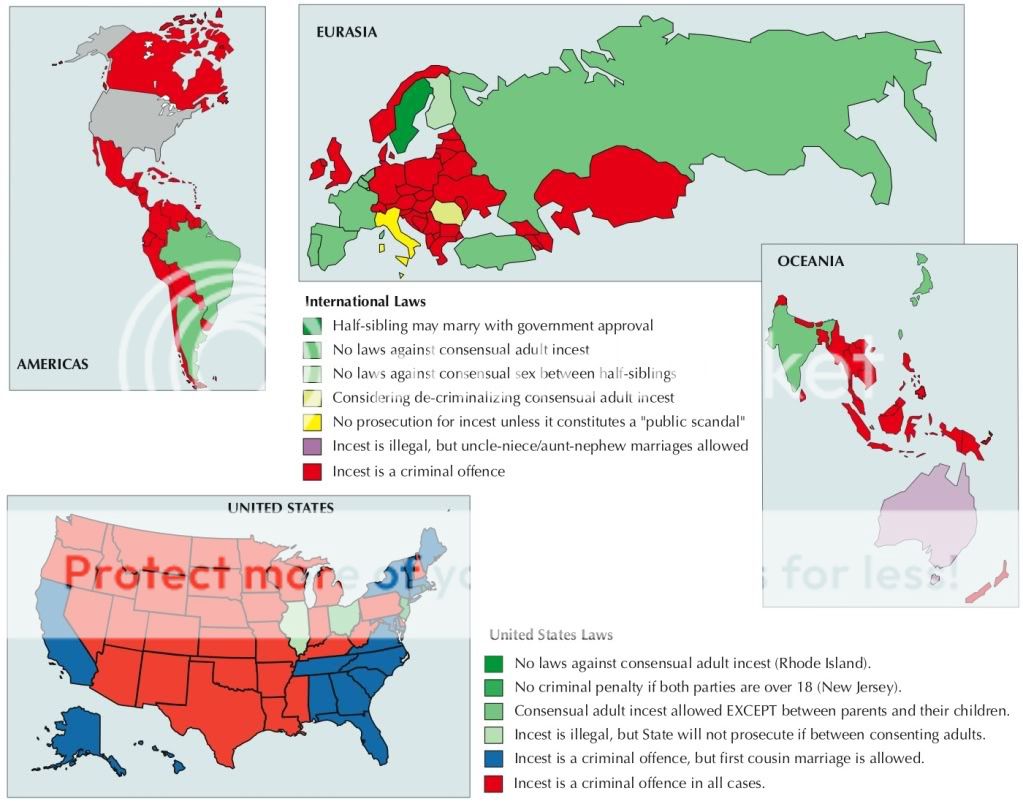
Believe it or not, there are still criminal laws in many places criminalizing consensual sex between adults, and there are still police officers who will investigate people for this "crime," still prosecutors who will take the case before a court, and still judges and jurors who will convict people and sentence them to prison.

It doesn't matter to them how loving the relationships are. It doesn't matter if they love each other more than they could love others, it doesn't matter if the lovers didn't even meet each other until they were adults. It apparently doesn't matter to the people interfering that every dollar or minute they spend trying to stop consenting adults from loving each other is a dollar or minute that could instead go into protecting people, especially children, against predators.

In addition to this persecution of consanguinamorous people, there aren't any protections against other forms of discrimination against the consanguinamorous, such as employment discrimination. There are still many states that don't have protections for LGBT people, either, and polyamorous people are even less protected than monogamous LGBT people.

I sometimes forget that people don’t follow the news and law as closely as I do for this blog, so they may be unaware of these things. So I want to share with you what I've learned.

First, note the disclaimer that there is an ever-present at the bottom of this blog. I'll mostly repeat it here:


The focus of this blog is consenting adults. This blog does not advocate anyone engage in activity that is currently illegal in their jurisdiction; it does advocate changing or repealing any law that prevents the freedom of association, love, and full marriage equality for adults. This blog condemns rape, sexual assault, and child molestation, and does not provide medical, therapeutic, legal, financial, or cooking advice. This blog links to other sites for informational purposes; it does not necessarily support everything at those links.
OK, with that out of the way, I'll continue as a friend.

The vast majority of people who have consensual sex with a close relative never get "caught." 10-15% of people in their early 20s will confide in surveys to having had consensual sexual contact with a sibling. The percentages rise in older age groups. That's just the people who will confide in the surveys, and doesn't include being with aunts, uncles, parents, etc.. The percentages increase in older age groups because there are more opportunities over the years. Many of those situations involve a moment or a fling or something that just lasts for season, but in other cases they are long-term romances and lifelong spousal relationships.

While most never get prosecuted, the threat is always there in so many places, and I regularly find news reports of such prosecutions. When people do get caught and publicly persecuted and, often, prosecuted, in almost every case, the lovers were outed and handed over to ax-grinding prosecutors due to one or more of a few factors (presented in no particular order):

1) Self-incrimination.
2) Being ratted out by a claimed witness.
3) Testing and reporting of a child's DNA.
4) Being caught in the act by law enforcement.

In other words, it isn’t like the police come door to door, scan crowds in public, or are doing stakeouts to catch consanguineous lovers breaking laws against consensual incest. That's the good news. But let's take a closer look at the bad news.

Self-incrimination. One of the problems is that people either "confess" or tell law enforcement way too much that they don't have to. One or more of them admit the relationship, often not aware it is (still, stupidly) illegal where they are, wrongly thinking if they explain it was consensual then of course the police will leave them alone. For a real-life example of this, see this posting. Law enforcement may also get a hold of some media (love letters, homemade videos) that documents the sexual aspect of the relationship. That's right... doing something so many other lovers do freely can be used against these consensual relationships.

Ratted out. Someone outside of the relationship, whether a nosy neighbor, a malicious ex, a jealous or envious family member, even a professional/academic/social rival sees something, hears something, or just gets a hunch based on how the lovers are smitten with each other and they contact the authorities. See this example.

Child. If someone dares to exercise their reproductive rights and have a child together, the DNA of that child is proof of parentage. Contrary to popular myths, most children born to close relatives are healthy and do not look any different than any other child. Many of the ones I've seen are beautiful children. But, if the child's DNA is tested and the results showing the parents are consanguineous reported to the authorities, depending on the circumstances it may be used as evidence against the lovers. See this example.
Caught in public. Many, many people have had sex in "public" places, usually without getting caught. Depending on the circumstances, police might send the lovers on their way. But, if in checking identification and asking questions, the police determine that the lovers are closely related (see "self-incrimination" above), they might arrest the lovers even when they would have otherwise let them go. See this example.

So what can those who enjoy consanguinamory do to protect themselves? Any of these steps might help.

1) Consult a lawyer. I am not a lawyer. A criminal defense or family law attorney might be someone well worth consulting.

2) Move to more enlightened states or countries. Moving also may get you away from those who are aware of your biological relation and would oppose your relationship. The best states in the US are Rhode Island and New Jersey. Perhaps the worst state is Texas, which technically criminalizes sex between first cousins.

3) Be careful who you tell and what you tell them. In the US, we have a Constitutional right against self-incrimination (see 5th Amendment) and the right to remain silent when arrested by law enforcement. It's a good idea when dealing with police to give them polite, brief "yes" or "no" or "I don't know" or "I don't remember" answers unless even one of those could incriminate you. In the US, you also have the right to an attorney and it is a good idea speak up and ask for a lawyer if you're held or taken in by police. Also in the US, unless there is imminent danger to someone, you don't have the let police into your home without a search warrant, and even search warrants can have limits. YOU may think something is obvious and gives you away, the police may even have figured it out, but staying silent about it can still protect you.

4) Be careful what you document. Many lovers enjoy taking video or pictures of themselves having fun with each other, but for the consanguinamorous, such media, if it falls into the wrong hands, can be trouble.
5) Have a cover story. Anticipate questions, whether from those you know you or those who don't who might not approve. There's nothing unusual or unconventional about family members living together, going places together, or frequently visiting each other. In extreme situations, consanguineous lovers might want to take on "beards," meaning pretending to have a relationship with (even marrying) others to direct attention away from their "forbidden" relationship. If someone does this, it is better not to deceive the beard(s) but rather have an agreement with someone who is fully informed. An example of an ideal situation along these lines would be if two siblings from one family married two siblings from another family. Such marriages have always gone on and were even popular in some places in the past, whether as real marriages or as beard situations.

6) Know your risk in having biological children together. Many consanguineous lovers opt not to take the risk, either for genetic reasons or legal reasons (or, like other people, because they just plain preferred not to have children). In some places, a credible defense if DNA proves a child was born to close relatives is to claim that the child was conceived through using a turkey baster or condom or sex toy that resulted in artificial insemination (the claim would be that the male ejaculated onto or into the object, which was then inserted into the female). In such places, it is the actual sex act that is criminal, not having genetic children together.
7) Stick to private places and lock the door when you get to the fun.


Note that most ethicists say it is OK to lie to authorities who are trying to enforce unjust laws or polices. An extreme example is a Nazi SS officer asking you, "Are you hiding any Jews here?" It was ethical to say "No." Well, I think that applies here, too, though the situation is not as extreme. It is nobody else's business if adults are having consensual sex.

This advice shouldn't even be necessary, but until we get to the point where we have relationship rights for all adults, including full marriage equality, consanguinamorous people should think about protecting themselves. Of course, some level of trouble is necessary to make change. Laws need to be overturned in courts or changed by legislatures, but it is up to each set of lovers to decide for themselves if they want to come out of the closet to push for those things. I have seen at least two couples come out publicly on Facebook, which resulted, in at least one of the cases, them being given trouble by some of the people who were supposed to be their friends. But the more other people realize that consanguinamory is a reality all around them, the sooner the persecution will be greatly reduced.

Police officers usually have some wiggle-room when it comes to investigating or arresting people can can look the other way if they choose. Prosecutors can choose not to prosecute. Judges can dismiss cases. Juries can refuse to convict (research jury nullification). So I beg these people to let consenting adults love each other without harassment, without prosecution.

Do you have any suggestions? Any tales to tell about what you've done to protect yourself, or being caught, or catching someone? What do you think, dear reader? Leave a comment or email me.

Friday, January 31, 2014

The Two Main Paths to Consanguinamory

There are two main paths to consanguinamory, or the objective reality that at least two closely biologically related people have sex, and perhaps an ongoing romance or marriage-style relationship. While the prejudiced may dismiss all consanguinamory as the same (in their small minds) inexcusable behavior, the differences in these paths do have an impact on the participants and those around them. This is why people who are on one path may not understand those on the other, or want to be associated with them.

One main path to consanguinamory is Genetic Sexual Attraction (GSA). GSA is an extremely intense attraction that may occur when close biological relatives meet any time after puberty either for the very first time, or the first time since the youngest went through puberty. These situations are likely to increase due to increased human mobility and the high rates of co-parents who do not stay together. Whether a marriage that involved at least one child ends in divorce, or a one night stand results in pregnancy, or anything between, a man and woman who have a child together may go their separate ways, often going on to have more children with others. The situations are are also likely to increase due to increase in the use of donated eggs, sperm, and embryos to have a child. In addition to the various forms of adoptions, some governments, such as some states in the US, allow someone to bring a newborn to a hospital, police station, fire station, etc, and surrender custody of the child with no penalty.

As you can see, there are many situations in which close relatives, such as full or half siblings, or a parent and child, can be reunited post-puberty.


Only some reunification/first contact involves a person experiencing GSA, but some estimates are as high as 50%. Even if there is mutual attraction (both or all, if more than two experiencing GSA), it doesn't always lead to sex. However, GSA is so strong that if it is mutual, it often does lead to sex sooner or later. The sex may not last for any number of reasons. In addition to all of the other reasons people may stop having sex with each other, there are external pressures on such relationships (like criminal law and social disapproval) or a conflicted conscience on the part of one or all involved due to years of sex-police thinking being drilled into their heads.

GSA is almost always a painful path for one reason or another.

Sometimes GSA leads to lasting, happy consanguinamory, but even if any internal pain is a thing of the past, there might be pain from outside interference. That's something I am trying to help change.

With the GSA path, the people usually have established identities and lives in which they are not known as related. For example, half siblings find out about each other in their twenties; the friends and coworkers of one, or both, don't know they are related if they haven't told them. Also, they usually don't have that history of the social connection to their biological roles. They haven't been functioning as brother and sister. A son given up for adoption at birth meets his birth mother twenty years later. He has a mother: the woman who raised him, if she is still alive. Still, someone experiencing GSA may seek to have that familial relationship that would have been expected should there have never been a separation. This is not always possible; it can be very difficult. The history is not there, and nobody can go back to being nine years old; nobody can reverse time.

In GSA relationships, as with any other relationship, it usually takes time for the people get to know each other. Almost always, they find remarkable commonalities.

Those who know of their biological relation may try to break them up or separate them, sometimes by force of law. This can be especially insulting if the person or people trying to douse their love was somewhat responsible for the original situation in the first place. Their actions denied these GSA-experiencers all of the typical parent-child or sibling relationship experiences; after those experiencing GSA have reunited (or met for the first time) and found happiness with each other, this happiness is threatened or taken away.

If the lovers don't want someone else knowing that they are, in fact, lovers, they may be able to use the cover story of making up for lost time with a long-lost relative. (In actuality, an enjoyable consanguinamorous relationship is, in their case, the compensation for that lost time.)

If the sexual aspect of the relationship ends, and does so acrimoniously, the risk includes again losing a long-lost relative. However, if the relationship lasts, it can be a very exciting and fulfilling one.


The other main path to consanguinamory involves close relatives who didn't grow under the separation conditions involved in GSA. This includes cousins (who can legally marry in some places), but it also includes...
-full or half siblings, either raised in the same home or interacting throughout childhood
-parents and their adult children, either with the child raised in the parent's home or with that parent throughout childhood through shared custody or visitation
-aunts/uncles with their nieces/nephews (close in age, or after all are adults)
-grandparents and adult grandchildren.

Cousins and siblings are probably the most common examples of consanguinamory.

On this path, consanguineous sex may begin (and sometimes end) as youthful experimentation between minors who are siblings, cousins, or aunts/uncles with nieces/nephews who are close in age. Sometimes it is more than experimentation, and a full-fledged love affair develops, and may continue into a marriage in everything but (usually) law. Or, it may begin later, at any in their adult life, as young singles or after a divorce or breakup or as seniors.

The consanguinamorous dimension of a relationship, when one person is significantly older than another, such as parent-adult child, may be added at any time after the youngest person reaches the age of majority. This can and does happen without any "grooming." (Grooming and abuse cases are another matter that I'm not addressing here, as I am writing about consensual, loving, healthy relationships.)


Differences from the GSA path include that the lovers have that existing social relationship with the familial context. Consanguinamory on this path builds on that, adding another dimension. Who is more loving, caring, or trustworthy? They already know each other extremely well. Still, there is even greater potential for inner conflict than there is with GSA as one or all of the lovers deals with the notion of "this is wrong," due to years of sex-police thinking being drilled into their heads for no good reason.

Lovers on this path may have had more opportunity to share physical intimacy, but a more difficult time hiding the true reason their demeanor lights up when their (secret) lover walks into the room. However, there is a long tradition of adult siblings or parents and their adult children sharing residence, so if they develop a spousal-type relationship, it can easily be concealed from the finger-waggers with that cover.

If the sexual aspect of the relationship ends, and does so acrimoniously, the risk includes general family disruption. However, if the relationship lasts, it can be extremely intense in a positive way, full of a layered and passionate love.

As I have already said recently, most romantic or sexual relationships don't last; if they did, most of us would still be in our first ones. But they should be allowed to develop and continue, or end, on their own merits, without interference from overbearing law enforcement, bullies, or self-appointed sex police. There are happy, health, lasting consanguinamorous relationships, and I say good for everyone in them. May they continue to share their fun, joy, and love.

Monday, January 27, 2014

Request For Polyamorous People

The more books we have like this, the better, so please consider responding. Here is the request...
My name is Richard Gilmore. I am a member of a MFFM quad. We have been in this configuration for over 13 years. My partner Elon and I have written a book called, Creating A Line Family. Our editor (Alan of Poly in the Media) made a good suggestion, include personal stories. So what we are looking for are interview volunteers who are members of a poly family. Here are some of the questions we would like to hear about.

1. What types of intimacies - besides sexual - do you share with your partners?

2. What vision, or long range plans do you have for your family?

3. How are household chores managed, both regular duties and emergent failures?

4. How is "family money handled?" By this we are talking about real property ownership, investments, community personal property, etc.

5. How will you support launching any children?

6. How do you make decisions as a group?

7. Do you plan, or have any family businesses?

8. Do any other issues come to mind?

You can see an early, rough draft of the book at http://www.line-family.info/
We really need personal stories to make the book come alive. Funny stories are great, stories of failures can also be instructive.

All names, locations and personally identifying details will be changed to protect everyone's privacy.

The book price will be as low as we can make it. We really want this information out there. Therefore we expect to make little to no money on this publication. That means all we can offer you is our sincere thanks and maybe a signed copy of the book.

Please message me to arrange an interview.

Thank you for taking time to read and consider our request.
Richard

Richard can be reached at rlg at 4dreality dot com.

I will add whether or not you contact Richard, if you want to be interviewed by me (see this interview I have done), pleas write me at fullmarriageequality at yahoo dot com.

Sunday, January 12, 2014

Genetic Sexual Attraction, Incest, and Consanguinamory


To act, or not to act, that is the question.

As always, I am talking about consensual sex, not molestation, assault, or rape.

Close relatives may experience mutual attraction as a result of Genetic Sexual Attraction (GSA), Genetic Attraction, Familial Sexual Attraction, or some other experience or phenomenon. I’m addressing these together because they all involve close relatives. These things can lead to incest (consanguineous sex, or consanguinamory) in the form of sibling sex, parent-adult child sex, cousin sex, etc. It may also lead to marriage or spousal relationships. While all sexual activity related to these can be called consanguineous, GSA-initiated consanguinamory is a special subset and it should be noted that opinions of those who have been in such relationships towards non-GSA consanguinamory range from support to indifference to uneasiness to condemnation.

Speaking of GSA, there is a split in the GSA community about whether to act or not (or to stop acting). Many people who have experienced GSA, prior to having the experience, had never considered the possibility of being attracted to a close relative and may have thought the idea disgusting, but they found themselves attracted to a close biological relative anyway. Those in the GSA community against acting or continuing to act have various motivations; a bad personal experience acting on GSA, a priority of obedience to laws (even if unjust), their personal sexual mores, and perhaps for some, intense emotion about something they never had or can no longer have. They may very well think they are sparing others pain by urging them not to act. But others say the pain for them was in delaying the reality that they had been reunited with someone who was now their true love.

I deal with common arguments against the rights to share love, sex, residence, and marriage on this page. But just because one should have the right to share these things with a relative doesn’t mean they should share these things in any given case. That is the point of why I am writing this.

ALL romantic or sexual relationships are emotionally risky. Most do not work out, or most of us would still be in our first one. As with any relationship, you should be the one making that decision for you, not anybody else. Don't let others decide for you. There are trade-offs and emotional risks in any relationship. With a possible consanguinamorous relationship, there are generally pros and cons, and with GSA, there is likely to be pain and struggle no matter what course is taken. Ultimately, each situation can have different factors than others, but there are some general considerations I will address.

If there is mutual attraction, and that is a big if, there are many things that should be considered before becoming more physically intimate. Notice that to one extent or another, these apply to relationships with nonrelatives as well.

First, the cautionary considerations…


1. Is this person right for you, right now? In this stage of your life, are you looking for a spouse? A partner? A roommate? A date? A dance partner? A friend-with-benefits? Is this person a good choice for that? (With a GSA situation, you may not know until you spend more time with them; some other times, you already know they aren’t. If you have been with this close relative all of your life, you should have a fairly good idea either way, which is one of the advantages of consanguinamory.) We’ve all known people, perhaps ourselves, who have been attracted to someone who is all wrong for us, or at least we were wrong for each other in that stage of our lives. Nobody should voluntarily subject themselves to a toxic person, relative or not, and some people aren't toxic, but they just aren't right for you because of personality differences, lifestyle differences, and wanting different things out of life. With parent-adult child GSA, there is sometimes (not always) a good reason why the child was kept away from the adult, or given away by the adult; sometimes in those cases, things have gotten better in the decades since. Whether or not a person is right for you may have to do whether you are just looking for recreation, a release, to express your love, or satisfy a curiosity.

2. Is it cheating? I am against cheating. I also generally support keeping a family together. This means that if one has existing vows to another that preclude entering into this new (or new level of) relationship, especially if there are children being raised in that home, I would urge against it. In a perfect world, everyone would talk it over and the addition would be accommodated, but I know this would be extremely unlikely in a relationship where closed monogamy is expected, or even in open or polyamorous relationships where someone doesn’t want to give up status as the primary.

Genetic Sexual Attraction presents a special situation as overwhelmingly powerful feelings flood a person, often suddenly and without warning. There still isn’t much awareness about GSA. Thus, you can have someone who would not otherwise violate their vows to another/others do that very thing. For example, there can be a woman happily married to a man in monogamous, closed marriage, and she would never have an affair with a coworker or neighbor or the brother with whom she was raised. But one day she finds out she has a slightly older half brother or one her age, and upon meeting, they have a powerful attraction and start to spend a lot of time together and engage in constant communication. Just their mere emotional bonding may be threatening to her husband; all the more so if the relationship becomes sexual. There is the possibility that if the husband remains, his wife may return to monogamy with him. But there is also the possibility that she will leave him for her half brother.


3. Are you willing to deal with the possible fallout? Emotional relationships will always have fallout, but with consanguinamory there can be legal, professional, familial, and social fallout. This blog supports the right of consenting adults to share love, sex, residence, and marriage with any consenting adults, but the present reality is that consanguinamory is illegal in many places, and even if not illegal, not legally protected. It is also looked down upon by some who take it upon themselves to be concerned with the love lives of others. Thus, coming out or being outed may result in prosecution, discrimination, bullying, and jealousy on the part of others. These factors can be minimized through moving to a location where consanguineous sex is not illegal or not prosecuted, and/or where your biological connection is not known. Discretion can be absolutely essential. There are too many power-hungry people in legislatures and law enforcement (and it only takes a few) who want to interfere in the love and sex lives of others, and much hateful prejudice among others who will discriminate against and harass your family if they find out something like this

4. Is there a possibility of a sexually transmitted infection?


5. If this is heterosexual, has fertility, the possibility of pregnancy, and contraception been discussed?

Now, for some encouragement…

6. There ARE people in lasting, happy, consanguinamorous relationships, some with the support of family and friends; there are people who had positive experiences with youthful experimentation or play.

7. Consanguineous sex, consanguinamory, and consanguineous marriages are not new things, nor are they rare. The fact is, these things have been going on for literally all of human history in various cultures and every level of society. From the rich to the poor, royalty to commoners, educated to ignorant, urban to rural, young to elderly, close family members have done everything from engaging in playful experimentation to forming lasting spousal relationships. Consanguineous sex is normal, natural, common, and can be enjoyable and beneficial.

8. Nothing ventured, nothing gained. If you’re right for each other, don’t deny yourselves, deny each other, or waste the lives of others by entangling them in an effort to avoid your true love. As a wise person who has been there puts it, “I ran from the one person who would have supported and loved me for who I am, not who he wanted me to be, or for what I could do for him and my children and I have paid the price for two decades.” Fortunately, there is a happy ending in that case.


9. It can be a wonderful experience or even a deep and abiding love. If the situation is just a matter of curiosity and exploration, who better to learn with? But if it is more than that, be assured that consanguineous lovers often report that consanguinamory is deep and powerful; that other relationships pale in comparison. It is a special bond that brings happiness, a caring partner, and security. Who cares for you more?

10. In instances of GSA, it can be positive compensation for something that was lost and can never be regained.


If there is love; mutual attraction, trust, and respect; compatibility in availability, goals, personalities, personal styles and habits (notice that these may take some time together to determine); and the above considerations have been made, don’t let anyone stop you.

Refer your family and friends to THIS page.

You may want to check out:

Suppression Brings Ongoing Pain

Avoid Hurtful People

Hate Adds Pain to Genetic Sexual Attraction

You can also contact me through fullmarriageequality at yahoo dot com.

(Edited to correct errors and for clarification)

Categories